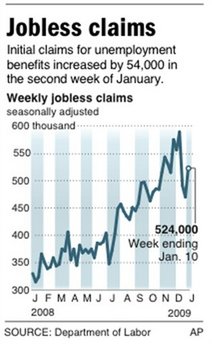
On becoming president, Barack Obama proclaimed his job creation goal to be 3 million jobs over the next two years. Yet in the last two months alone nearly 1.2 million jobs have been lost: 577,000 in December and 598,000 in January. The December figure was revised upward by the government, which had originally estimated it at 533,000. Economists expect the monthly number to be even worse in February.
With each new layoff announcement, the target number for jobs to be created goes up. The latest target is 4 million, even though right-wing Republicans are whittling down the stimulus package.
The official unemployment number has jumped from 7.2 percent to 7.6 percent. But this is not the total unemployment number, which includes those who have stopped looking for work and those working part time because they cannot find full-time work. That has jumped from 13.5 percent to 13.9 percent.
In effect, this means that to achieve full employment for the approximately 154 million people in the workforce, some 21.4 million new full-time jobs would be needed now—and this number is growing rapidly each month.
Every worker should do the math. The so-called stimulus package, even assuming that it could meet its goals, appears more and more anemic compared to the momentum of the crisis, which is growing each week, each month. Creating relatively few jobs at a snail’s pace leaves tens of millions of workers unemployed and underemployed. Tens of millions more are vulnerable to becoming part of the unemployment statistics.
Every new grim announcement by the government on unemployment, foreclosures, evictions, homelessness, the loss of health care, hunger, record numbers applying to hard-pressed food banks, an increase in child poverty, etc., should become a big wake-up call for the multinational working class to get organized for a fightback.
Actions being planned
One important attempt to begin the crucial fightback is taking place in New York City where the Bail Out the People Movement is forging a grassroots alliance for struggle and calling a national action against the bankers on Wall Street on April 3 and 4. While the mobilization is targeting the bankers, it has a broad program with a focus on stopping the layoffs. Hundreds of endorsers and contingents are coming aboard from every region of the country.
Along the same line, a network of local coalitions in cities around the country, from New York to Boston to Los Angeles, is organizing to make May Day 2009 a day of struggle and unity to fight back against attacks on immigrant workers and to strengthen the struggle against the economic crisis. Many of these coalitions played key roles in the great May Day 2006 strike/boycott of millions of immigrant workers.
At this moment a delegation representing 250 workers, most of them immigrants, who sat in at Republic Windows and Doors in Chicago is touring the country. These workers occupied the plant for five days until they won their severance pay and back pay. They are telling their inspiring story to standing-room-only gatherings of trade unionists and activists. The workers are from the United Electrical Radio and Machine Workers, Local 1110. The tour is sponsored by Jobs with Justice.
The boldness of Local 1110 inspired the solidarity of the labor movement and the political movement. These workers set a living example of reviving a tactic–the sit-down strike—that was used in the 1930s on a massive scale to win the greatest victories in U.S. labor history.
Local 1110 carried out its sit-down strike in Chicago in the midst of a growing economic crisis. But these workers are not unique. All over the country there are rank-and-file workers, lower-level union officials, shop stewards and trade union activists at all levels, as well as sympathizers with the labor movement, looking for a way to fight back.
Vast network of potential power
There are now 16 million workers in the organized labor movement. There are tens of thousands of local unions around the country, thousands of them under attack by the waves of layoffs. There are hundreds of municipal and regional labor councils whose members are under siege or living in fear of layoffs, shortened hours and demands for concessions.
This vast network of potential working class power is lying dormant as the top labor leaders try to avoid mobilizing the workers to push back. The labor leadership is understandably focused for the moment on pushing through a legislative victory for the Employee Free Choice Act, which legalizes the card check system for union organizing. But this measure, important as it is in the day-to-day campaign to organize unions, will not meet the urgent needs of the millions falling under the ax of layoffs or losing their health care and their homes on a daily basis.
Most importantly, these measures fail to blunt future layoffs. The layoffs arise from the urgent needs of the capitalists to preserve their profits and cut their losses.
The rank and file must get organized within their locals, within their unions and within the union movement as a whole and unite with the communities and activists all over the country to develop a genuine fighting force. Neither John Sweeney of the AFL-CIO nor Andrew Stern of SEIU/Change to Win has represented the labor movement or the working class as a whole in this crisis.
French workers set example
These leaders should contemplate what just took place in France, where 2.5 million people, led by the unions, struck and/or marched to demand priority be given to protecting and creating jobs. The French workers shut down major cities, from Paris to Marseilles, as all the unions united for a show of strength. Of course, the French working class movement has a great tradition of class struggle.
But the workers in the U.S. have a history of struggle as well. During the 1930s they carried out marches and rallies of the unemployed. The Workers Alliance and the Unemployed Councils put hundreds of thousands of people who had been evicted back in their homes. They carried out citywide general strikes. The workers initiated hundreds of sit-down strikes. This is a history and tradition that can and must be revived.
The bosses, bankers and their “experts” are fully aware of this history, more so than are most workers at the moment. That is one of the reasons they were so anxious to settle the Republic Windows and Doors sit-down: the fear that it would become contagious in the midst of a layoff crisis.
Each time they announce a new figure for layoffs that is “the highest” since 1983, or 1972, or declare the crisis to be the “worst since the Great Depression,” they keep their fingers crossed that the working class in general, including the oppressed—the African American, Latina/o, Asian and Native communities—will get frightened, demoralized and retreat into trying to deal with the crisis on an individual basis.
But everyone knows in their bones that this crisis cannot be fought on an individual basis. Organization is the most important weapon that the working class and the oppressed have.
The capitalist system is in the midst of a major, global crisis of overproduction. There is a glut of commodities that cannot be sold because the entire capitalist class all over the world, in the race for profits, has lowered wages and increased production. That is what is called capitalist anarchy of production.
In the auto industry the global capacity could produce 90 million autos a year. Present production is 66 million a year. Semiconductors are used in everything from iPods to airplanes, yet the semiconductor industry is operating at 66 percent of capacity. Even the oil industry is operating far below capacity.
Why? Because the masses do not have the money to purchase the vast inventories of commodities that have been built up by their own labor as the bosses race for profits and market share. So production shuts down. Plants and offices are destroyed or sit idle.
The only thing that can change the course of the crisis is the conscious, organized intervention of the workers and the communities to defend themselves–to demand the right to a job, to housing, to health care, to education and to social services of all kinds.
The process of getting organized for struggle is a difficult one. But there is no other course. The only social force that can bail out the workers, the only force that is going to stop the layoffs, the foreclosures and evictions, the racist attacks, the sexist inequality of wages and abuse of women, the raids on undocumented workers—that is going to stop all forms of oppression—is the might of the organized, multinational working class.
Labels: april3 and 4, bail out the people movement, bailout, layoffs, march on wall street, stimulus package
from
We Need a Revolution..... A Labor Rights Revolution:
While it's good that the Congress has taken upon itself to extend unemployment benefits, this does little to no good when American employment law is tilted in favor of the employer. It's time that the Congress work to pass a new employment law that recognizes that a contract is inherent in each employment relationship, and enforce the social obligations employers undertake when they choose to hire people to do work they benefit from.
Why is it that Congress is willing to spend trillions of dollars to remove risk from lives of people who are being paid to taken on uncertainty, yet have done nothing to provide certainty to the millions of Americans who work for wages? read full post
Labels: bailout, congress, layoffs, stimulus program
By Fred Goldstein
Published Feb 1, 2009 9:26 PM
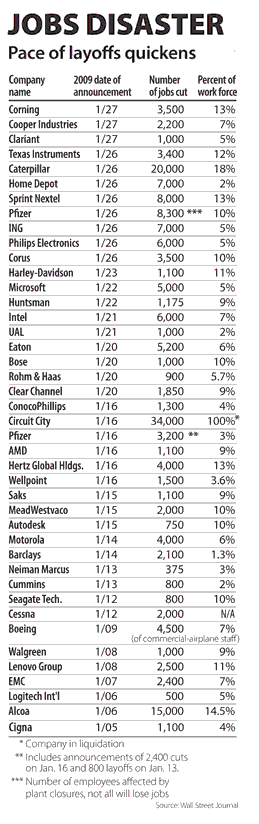
By the time the stock market closed on Jan. 26, 11 large U.S. corporations had announced a total of 60,000 new layoffs in just that one day.
Caterpillar, the largest manufacturer of construction and mining equipment in the world, announced 20,000 layoffs, or 18 percent of its global work force.
Home Depot, the largest home equipment dealer in the U.S., announced 7,000 layoffs and the closing of 34 of its high-end EXPO Design Centers.
Sprint Nextel will lay off 8,000, or 13 percent of its workforce.
The giant drug company Pfizer is projecting 8,300 layoffs after its $68-billion purchase of another huge pharmaceutical, Wyeth.
Toward the end of the day Texas Instruments announced another 3,400 layoffs, 12 percent of its workforce, and there was a belated announcement that IBM had sent out pink slips to another 2,800 workers.
Caterpillar, which had sales of $12.92 billion last quarter and is a bellwether for the economy because of its global reach and its crucial role in construction worldwide, predicted that 2009 would be its worst year since the end of World War II.
Altogether, large U.S. companies publicly announced more than 170,000 layoffs (see accompanying chart) in the first four weeks of this year, but hundreds of thousands more are expected to be added when the government releases its monthly statistics early in February.
As workers lose their incomes, the defaulting on mortgage payments, credit cards, auto loans and student loans keeps rising. As the defaults rise, the bad debts on the books of the banks go up. The deepening crisis of the workers aggravates the financial crisis of the bankers.
Gov’t rushes to save banks
The capitalist government in Washington has not been trying to solve the banks’ problem of insolvency by rushing to the aid of the millions of workers who are defaulting on their debts and losing their homes and jobs. Instead, it has put limited aid to the workers on the slow track while it rushes to find ways to bolster the banks.
Citigroup and Bank of America had merely to apply to the government, filling out a perfunctory request form, and they immediately received $45 billion each in installments, with guarantees of $300 billion and $100 billion, respectively, to cover bad debts. Other banks have received similar handouts, adding up to hundreds of billions of dollars in direct infusions of capital and in bad debt guarantees.
As fast as the Obama administration draws up plans for its stimulus package, the deterioration of the economic situation outpaces these modest plans to deal with it.
So far $700 billion has been officially appropriated for the financial crisis. But, according to an article in the Washington Post of Jan. 24, “with the economy deteriorating rapidly, financial companies are incurring trillions of dollars in losses on failing mortgage loans and other assets, forcing the federal government to consider substantially expanding its response to the crisis. ... Leading economists and lawmakers calculate that hundreds of billions more could be required.” There is talk of raising the official bank bailout fund to $1 trillion—in cash.
As for the foreclosure crisis, the administration has officially pledged $50 billion to help homeowners avoid foreclosures. But Goldman Sachs estimates there is more than $1 trillion outstanding in bad mortgage debt. At a private luncheon on Jan. 22, economists were talking about needing $250 billion for the foreclosure rescue program.
“Foreclosures have skyrocketed,” according to the Post, “with an estimated 8 million families expected to lose their homes over the next four years.”
Losing 500,000 jobs per month
Mark Sandy of Moody’s Economy.com told the Post: “Conditions are eroding far more rapidly than anyone anticipated. ... The job market is now consistently losing 500,000-plus jobs per month, something you couldn’t have envisioned eight to 12 weeks ago. Losses in the banking system over the last week or two have been much larger than people had been expecting. We’re coming to the realization that these things are self-reinforcing and the problems aren’t developing in a linear way. They’re getting worse very rapidly.”
The bourgeois “experts” cannot fathom their own system. They are utterly taken aback when capitalism behaves the way it has been behaving since the first real global collapse in 1825.
The capitalist system goes through a cycle of expansion that leads to a glut of goods, stocks, land deals and so on that always ends up in a crash. As each capitalist or capitalist grouping fights for market share of commodities, gambles on speculative gains in the stock market, the bond market, the real estate market, etc., things always end up in a catastrophe, which the bosses then push off onto the workers.
As capitalism has decayed under imperialism, has become more financial, more parasitic, more speculative, the tendency increases for the crashes to be more devastating.
Only the tunnel vision of capitalists driven by profit lust could keep them and their experts from seeing the inevitable end of this anarchic system of production and finance:
• No capitalist knows if the commodities produced can be sold.
• No one knows if the stock they buy will go up or down.
• No one knows when the upward cycle of speculative buying and selling of land or houses will reverse itself and come crashing down with a vengeance.
Furthermore, it was clear to all who wished to see that selling junk mortgage bonds around the world to institutions, municipalities and states alike, while calling them AAA, highest-rated, could only result eventually in a global crisis.
The financiers who stand at the pinnacle of capitalist society, the bankers who control the financial resources of society and therefore dictate the fate of hundreds of millions of workers all around the world, have used those resources in a mad race after profits—by any speculative, fraudulent means necessary. And they have brought the system to ruin.
Now the capitalist government must step in with trillions taken from the workers and the middle class and bail out the banks, because that is the only way they can conceive of under present circumstances to bail out the capitalist profit system.
Government intervention shows above all, however, that bankers are completely unnecessary to the functioning of society. Their only role is to get rich by financing exploitation and debt.
What capitalist ‘nationalization’ means
Right now “nationalization” of the banks is being discussed. It is a measure of the feeling of powerlessness to control their own capitalist system that economists, politicians and advisers are even contemplating the very thought of nationalization of the banks. In the days before this crisis, no one in the establishment would have dared to introduce this idea, even into the most private conversation. The word “nationalization” was not in the vocabulary of U.S. bourgeois society.
But this crisis has forced sections of the ruling class to think the unthinkable.
Nationalization under the capitalist class, that is, the takeover and running of a bank or an industrial corporation or an industry, has historically been used for the purposes of rescuing the capitalist bank or enterprise from complete ruin. The goal has been to take it over temporarily, put the enterprise back on its feet until it becomes profitable again, and then sell it back to the bosses.
In other words, it has been used to strengthen the system of exploitation when some aspect of the system has become weakened.
The nationalization of the major enterprises of British industry after World War II is a classic example. It was carried out by successive Labor governments with understandable popular support from the workers and was presented as a socialist measure. But it left the capitalist ruling class intact. Once the economy had completely recovered, Prime Minister Margaret Thatcher began to give back to private capitalists what was profitable.
Time for a people’s fightback
In the meantime, workers are losing their homes and livelihoods. They are being battered from pillar to post on a daily basis by the inhuman wave of layoffs and foreclosures. The capitalist government in Washington and the financial authorities at the Treasury Department and the Federal Reserve Board have already given the banks over a trillion dollars and are now rushing to give them more on an emergency basis.
What is the real emergency, which needs immediate attention? It is that tens of millions of workers and their families are rapidly being driven to the wall by the economic crisis. Social tensions are increasing. Racist killings and beatings are increasing, especially by the police. Arrests of the poor are rising as more workers are driven to commit crimes of survival. The scapegoating of immigrant workers is growing under the impact of the crisis.
The workers and the oppressed are not just losing paper wealth. They do not have millions of dollars stashed away in personal wealth to be tapped for a rainy day. They are losing the means to sustain living.
The only way out of this crisis for the working class is to organize a massive fightback.
A movement is taking shape to launch peoples’ assemblies and community-labor alliances whose aim is to broaden the struggle by uniting the various movements into a common front.
This is an essential first step for the workers and oppressed to put their needs on the agenda, ahead of the Wall Street billionaires.
Labels: Caterpillar, home depot, layoffs, low wage capitalism, sprint, texas instruments
By Fred Goldstein
Published Jan 25, 2009 9:56 PM
The record wave of layoffs that seemed to peak in December is continuing into 2009.
At the same time, hundreds of billions of dollars in aid are flowing from Washington to the banks and corporations, not to the unemployed. Reviving corporate profits has taken precedence over providing desperately needed jobs or calling for an immediate end to foreclosures and evictions.
Circuit City announced it is laying off 34,000 workers by the end of March—the largest mass firing since the current crisis began. This second-largest electronic retailer in the U.S. is closing 557 stores.
Just in the first two weeks of this year a series of other layoffs has been announced.
Motorola, which laid off 3,000 workers last October, has announced another 4,000 jobs will be cut. Hertz announced 4,000 jobs will go worldwide. ConocoPhillips will lay off 1,350, Pfizer 2,400, WellPoint 1,500, Saks 1,000 and Neiman Marcus 375. Advanced Micro Devices (AMD), Blue Cross/Blue Shield and other large companies are also scheduled to announce new rounds of layoffs.
These are only the most publicized firings.
The official unemployment rate, which was 7.2 percent at the end of 2008, is expected to shoot up rapidly in the coming months as the bosses continue the onslaught without mercy.
However, there is a less publicized but also official figure called “total” unemployment—and it has reached 13.4 percent. The first thing to remember about this figure is that it amounts to 20 million workers. It includes people who couldn’t get anything but part-time work when they need to work full time, plus the millions who have stopped looking altogether, termed “discouraged” workers.
At the present rate, millions more will lose their jobs in the coming months. Last year 2.6 million lost their jobs—a huge number but still deceptively low when trying to project what will happen this year because, of the 2.6 million, 2 million lost their jobs just in the last four months of 2008.
There is no question that an emergency jobs program, which would involve the immediate direct hiring of millions of workers at living wages, with benefits, and a freeze on layoffs, is urgently needed to stave off the growing crisis of the working class and the oppressed people.
However, instead of reaching out directly to assist the workers who are suffering from the capitalist crisis, Washington and Wall Street are reaching out to bolster the capitalist system and aid the capitalists who caused the crisis in the first place.
Why ‘stimulus’ can’t work
Wall Street told the incoming Obama administration to get hold of the $350 billion fund Congress passed to bail out the banks and use it to clean up their bad loans. In addition, the Democrats have submitted an $825 billion “stimulus” package.
There are many progressive features to the package, such as increases in Pell grants, reduction of payroll taxes for workers, rural assistance, additional food stamp aid and unemployment insurance. But these features, including the declared goal of creating 3 million jobs in the next two years, are utterly inadequate to meet the massive crisis that is unfolding at a rapid rate.
The package calls for $550 billion in direct spending over two years. Some 90 percent of this spending will go through private capitalists. The bill sets up contract procedures and deadlines that range from one year to more than two years for fulfillment. It has no mandatory hiring or wage requirements, save a nebulous “prevailing wage” stipulation. There is no requirement to stabilize employment by requiring that workers be retained for any period of time, nor any funds to provide such stability.
The 20 million workers already considered unemployed or underemployed—and this December figure is sure to rise in the new year—will have to wait for the stimulus package to go into effect. When it does, they will then have to compete for an estimated 1.5 million jobs to be created this year while the government bureaucracies at the local, state and federal levels negotiate contracts with competing capitalist interests and their lobbyists seeking to get a piece of the pie.
None of these bosses has the goal of providing good jobs at living wages with benefits. To them, the goal is to revive and maximize profits.
The entire process is corrupt, agonizingly slow, and totally uncertain as far as the workers are concerned. Furthermore, whatever hiring these bosses do could be cancelled out within a year or less by the drying up of funds or shrinking of the market.
The working class and the communities have no other recourse but to begin organizing on a mass basis to demand jobs now—at living wages.
Need for a direct jobs program
Millions are already unemployed. Millions more face layoffs unless an immediate, direct jobs program is put in place. It can be done. During the Great Depression of the 1930s, government jobs were put in place within two weeks after job programs were set up.
It won’t happen automatically. “Jobs or income” must become a mass demand, backed up by mobilizations, jobs marches and organizing the unemployed, in unity with the employed, who also need the security of jobs or income.
Regarding the bank bailout fund, $20 billion in cash and $100 billion in government-absorbed losses have been promised to Bank of America, which had already received $25 billion earlier. Citicorp is expected to announce $10 billion in new losses, which the government will absorb. Citigroup has already received $45 billion in bailout money and the government has given it a guaranteed backup of $300 billion to cover problematic loans.
The $350 billion bailout doesn’t include these huge new backup commitments. Its goal is to make the banks solvent by dealing with hundreds of billions—the investment bank Goldman Sachs says it’s more like $1 trillion—of remaining bad loans.
The fact is that these bad loans on the books of the banks are for the most part a mirror image of the suffering of the masses. Why are the loans of Citicorp, Bank of America and other banks going bad? Because of credit card defaults, auto loan defaults, student loan defaults, mortgage loan defaults and every other kind of unpayable debt. As people lose their jobs, have their wages and salaries cut, lose their health care, etc., they sink deeper and deeper into debt.
The bankers and the rich investors behind them are losing paper wealth, but their “balance sheet” problems arise from the direct material suffering of the masses. The working class and the middle class are unable to pay their bills, are losing their homes, their cars, their electricity and gas, their health coverage and every other means of survival.
Banks don’t lend when markets are glutted
The handout to the banks is being justified as an attempt to get them to start lending to companies and consumers, which will then get the economy rolling again. But this is a complete fiction. The problem of lending arises not from arbitrary stubbornness by the bankers. It arises from the lack of opportunity of the banks and the corporations to make profit once a crisis of capitalist overproduction hits, with its rising inventories and falling sales leading to falling production. After all, the bankers are in business to make profit.
The term “overproduction” has nothing to do with whether people need goods. It is when more commodities have been produced than can be marketed—i.e., sold at a profit.
The crude facts of capitalist overproduction are obvious. The U.S. auto industry has gone from producing 16 million cars annually to 13.2 million last year, and is expected to drop to 12 million or less this year. Steel production, which is a barometer of the economy, dropped from 2 million tons in November to 1 million tons in December. In recent decades, hundreds of thousands of steel workers were laid off as the industry consolidated and shrunk itself. Now, overproduction has hit again. It is estimated that 20,000 steel workers will be laid off in the coming period.
The overproduction of housing and the consequent crisis in the construction industry and all its ancillary industries is getting worse with each foreclosure.
Giant technology companies like Motorola, Nortel, AMD and Intel are suffering losses due to overproduction and hence executing layoffs. Under those conditions, the banks see no profit in lending, no matter how much money the government hands them.
In fact, they are using their bailout money not for lending but to strengthen themselves financially. According to a New York Times survey of two dozen banks, “The overwhelming majority saw the bailout program as a no-strings-attached windfall that could be used to pay down debt, acquire other businesses or invest for the future.”
At a recent conference at the Palm Beach Ritz-Carlton, “Bankers mingled with investment analysts at an ocean-front luxury hotel, where the agenda featured evening cocktails by the pool and a golf outing at a nearby country club.” They were there to discuss the bailout funds. Referring to the government’s Troubled Asset Relief Program, conference organizer John C. Hope III, chairperson of the Whitney National Bank of New Orleans, said, “We see TARP as an insurance policy.” Hope figures that, “No matter how bad it gets, we’re going to be one of the remaining banks.” (New York Times, Jan. 18)
So much for lending, job creation and recovery.
The “crisis” of the bankers and bosses is calmly discussed at luxury watering holes, while the workers are suffering the greatest attack in three generations.
The only way to get a real working-class recovery program is to organize to shake up the entire capitalist system until the bosses are forced to provide jobs and/or a livable income.
Goldstein is author of the recently published book, “Low-Wage Capitalism: Colossus with Feet of Clay,” which can be ordered through www.lowwagecapitalism.com.
Labels: Circuit City, jobs, layoffs, low wage capitalism, motorola, unemployment
By Fred Goldstein
Published Jan 15, 2009 9:01 PM
The intensifying capitalist crisis, which is bringing greater and greater suffering daily, is leaving the workers and the oppressed with no alternative but to organize a fightback. The deadly waves of unemployment, foreclosures, homelessness, hunger and repression are spreading while the ruling-class politicians and experts debate over the terms of the so-called “stimulus package.”
With 533,000 jobs lost in December, official unemployment went up to a 16-year high of 7.2 percent. The annual job loss for 2008 was over 2.59 million, the highest since World War II. The rapid rate of layoffs has brought the official number of unemployed to 11.1 million workers.
Unemployment of Black men over the age of 20, which was already officially double-digit, jumped from 12.1 percent to 13.4 percent in December. For African-American youth from 16 to 19, the figures were a staggering 32.2 percent rising to 33.7 percent in the same month. White youth unemployment also rose to 18.7 percent.
The rarely published figure of “total unemployment” grew from 12.6 percent to 13.5 percent. Total unemployment includes those workers forced to take part-time work who need full-time jobs as well as workers who are known to have become so discouraged that they have stopped looking for work.
The average number of hours worked was down to 33.3 in December, the lowest since these records were first kept in 1964.
The most important aspect of the December figures is that December is usually a month of increased hiring, even during slow times, as retailers gear up for holiday sales, manufacturers put on additional workers to fill rush orders for inventory, and the restaurant and entertainment industries have higher sales.
Instead, December saw the biggest decline in retail sales since record keeping began in 1970, despite price-slashing sales of 50 to 70 percent off and buy-one-get-one-free offers. The International Council of Shopping Centers estimated that 148,000 retail stores shut down in 2008. It projected that another 73,100 retail stores will shut down in the first six months of 2009. The closures would result in the loss of 625,000 to 800,000 retail jobs. (Washington Post, Jan. 9)
‘Stimulus program’ smaller than a band-aid
Considering the catastrophic wave of unemployment, with at least 20 million jobless or severely underemployed right now, and the prospects for a massive increase in the coming period, all the speculation about whether the “stimulus package” will add 3 million or 3.5 million jobs over the next two years seems utterly inadequate.
The government figure of 11.1 million unemployed, or 7.2 percent, is based upon a workforce of 154 million. The more realistic “total unemployment” figure cited above of 13.4 percent equals 20.6 million, according to the government.
Furthermore, the stimulus package now being projected amounts to $775 billion. Of this, 40 percent is in tax cuts, which are not necessarily going to create jobs. And, worst of all, 90 percent of the spending is to go to private capitalists. So it is largely a handout to the capitalists in the hope that they will create enough jobs.
With all the talk about studying the New Deal, this program takes an opposite approach to that of the Roosevelt administration. While the New Deal was purely a band-aid, filled with limitations and flaws and calculated to save capitalism by preventing a mass uprising of the workers, the Works Progress Administration (WPA) nevertheless provided direct jobs to 8 million workers during the decade, or one-fifth of the workforce. At any given time, anywhere from 2 million to 3 million workers were employed by the government in these programs—the equivalent of 9 million to 10 million today.
The present plans for government spending set up a situation in which some 20 million unemployed workers will have to compete for 1 million to 1.5 million jobs in the coming year—assuming that the job creation projections are anywhere near correct. Such a situation in which workers are desperately seeking scarce jobs will tend to lower wages, set worker against worker and help the bosses.
The workers should of course take advantage of any opportunity to get new jobs created to help feed themselves and their families. But they must not sit back and let the economic “experts” in Washington and Wall Street dictate the terms of the economic package. They must get organized to impose their own economic demands on the capitalist government.
They could start by demanding that every nickel of the more than $1 trillion already given to the banks be taken back and made available for jobs and services to the workers and the communities. The banks are so arrogant that they won’t even tell the government what they are doing with this money.
From bailout to fightback
The struggle is in its early stages and the workers are on the defensive. It is natural that at this stage popular organizations want to take advantage of the term “bailout” to expose the handouts to the banks and the bosses. But, as the struggle progresses, the concept of the capitalist government bailing out the people has to be shifted to the concept of the workers fighting back.
The funds to stem the crisis have to be put under the supervision of the workers, the unions, community organizations and other mass organizations—and not the bosses. It is the masses who are suffering from the crisis. They should be empowered to deal with it.
Only the masses will enforce a living wage, job guarantees, union rights, anti-racist practices and rights for women workers. The capitalists are skilled and experienced at manipulating government subsidies that are supposed to go for creating jobs. Instead they turn things around to maximize their profits. Relying on profiteering capitalists—and there is no other kind!—to save the working class is the worst possible course to pursue.
There must be a movement toward creating organs of popular power at the local, regional and national level to stop the layoffs and defend the workers’ right to a job; to demand a guarantee of jobs or income; an end to foreclosures and evictions; to organize the unemployed and the employed into a united movement demanding jobs for all.
As the crisis unfolds, the question must be raised, what is the cause of the crisis? Paul Krugman, a liberal economist, cites the fact that the U.S. economy could create $30 trillion worth of goods and services in the next two years. That would be sufficient to vastly reduce unemployment.
Krugman, who recently won a Nobel Prize for economics, restricted his commentary to a criticism of Barack Obama’s economic program. He brushed by the fundamental question. He did not bother to ask why, when there is the economic capacity to employ all the workers, is unemployment going through the roof?
The answer is that while the U.S. economy can produce $30 trillion worth of goods and services, it is in the form of commodities that must be sold for profit and only for profit. Human need means nothing to capitalism.
It is not as if the masses of people do not need the $30 trillion worth of goods and services. In fact, right now they are being deprived of the very means of life by an economic storm artificially created by capitalism itself.
The masses have been impoverished for more than 30 years by union busting, wage and benefit cuts, massive destruction of jobs at living wages and their replacement by low-wage jobs. At the same time the corporations have vied with each other to capture markets and sell more and more—purely to make more profit. They fostered every kind of debt—credit card debt, mortgage debt, auto loan debt and so on—to keep the profits rolling in.
Finally the entire edifice has come crashing down in a crisis of capitalist overproduction. There are too many autos to sell at a profit. There are too many houses to sell at a profit. There is too much steel to sell at a profit. And so on. It has led to the wave of layoffs, foreclosures, evictions, hunger and homelessness.
As a system of exploitation for profit, capitalism itself is at the bottom of the crisis. As the workers and the oppressed awake to demand their rights, the ultimate aim must be the destruction of capitalism and the erection of a system run for human need, not for profit. That system is socialism.
Goldstein is the author of the recently published book “Low-Wage Capitalism: Colossus with Feet of Clay.” See lowwagecapitalism.com for information about the book and how to order it.
Labels: fred goldstein, jobs, layoffs, stimulus program, unemployment, wall street
By Fred Goldstein
Published Nov 20, 2008 10:38 PM
When Barack Obama first began his campaign back in 2006, he and his advisors and backers in the establishment had as a priority trying to deal with long-neglected aspects of U.S. capitalist society that were in decay and were endangering the world position of U.S. imperialism.
The festering issues of health care, global warming and energy, declining education, antiquated infrastructure, the global isolation of U.S. imperialism and many others were on the agenda for a future Obama administration, which was supposed to “reach across the aisle” and work out bipartisan solutions. But these were all policy issues, issues of capitalist decay arising during a period when bourgeois politics has been in a factional logjam, unable to resolve anything other than to hand the corporations whatever they asked for and attack the workers and the oppressed—during the Clinton as well as the Bush administrations.
Now, as Obama gets ready to take office, the policy issues he wanted to address all have to be subordinated to an acute systemic crisis that is global in scope and historical in proportion.
Some 1.2 million workers have lost their jobs so far this year. Unemployment has jumped from 6.1 percent to 6.5 percent and is projected to soon rise to over 7 percent. Consumer spending dropped a record 3 percent in October. Retailers are girding for the worst shopping season on record.
Citibank has just announced 10,000 new layoffs [two days after this speech, the number rose to 53,000—ed.]; Sun Microsystems has announced 6,000 new layoffs; Circuit City, the second-largest electronics retailer in the country, closed down 155 stores and is filing for bankruptcy; and the second-largest mall operator in the country, General Growth Properties, which operates 200 malls in 44 states, is on the verge of bankruptcy.
Intel, the largest microchip maker in the world, has suffered a major decline in revenue. Caterpillar, the largest construction equipment maker in the capitalist world, is planning for a downturn. GE, a giant multinational conglomerate, is planning to cut back investment and workers.
The auto industry is in crisis, with sales dropping and losses and layoffs rising. General Motors is hinting at bankruptcy in a public relations campaign to get a bailout from the Treasury—also a dangerous game of psychological warfare against the United Auto Workers, as the company is trying to set the stage to reopen contracts and get major concessions. GM recently announced it will end health care coverage for 100,000 white-collar retirees by the end of the year.
As the G-20 meet in Washington, the capitalist economies of Europe and Japan are in recession. This is the first time since World War II that the three major centers of imperialism—the U.S., Europe and Japan—have gone into recession within the same year. Japan, with the second-largest economy in the capitalist world, has had six consecutive months of contraction; Germany, the fourth-largest economy, has had six.
China, Brazil, Russia and India, the world’s most populous countries, have also had major declines in growth in the last quarter.
It is evident that there is a crisis of production and employment in the entire economic system.
The cause of the crisis can be reduced to two words: capitalist exploitation.
Why are all the toxic mortgages and other debt-backed securities going bad? Because they were based on collecting the future wages of the workers. Mortgage debt, credit card debt, school loan debt, auto loan debt, debt to pay medical bills, and all the other debts were bundled up and sold around the world. After 30 years of falling wages and a growing consumer credit system, the working class has become deeply indebted. African-American, Latin@, Asian and Native workers have suffered the most, especially single women.
Interest and fees on working-class debt have become a major source of profit for finance capital. The capitalist class, in its various forms as lenders, mortgage brokers, credit card companies, banks, auto finance companies and so on were taking advantage of the dire needs of workers in order to promote credit. These money grubbers turned around and resold the workers’ IOUs in bundles to make a quick profit.
Meanwhile, other sections of the capitalist class were intensifying the exploitation of workers on the job by busting unions, cutting wages and benefits, shortening hours, laying off and outsourcing to contract labor. The medical insurance industry, pharmaceuticals, hospitals, all raised costs to boost profits. Agribusiness and the oil barons raised the price of food and fuels, fueling inflation in the things workers need to live.
Sooner or later the whole debt structure had to collapse—and the cause was capitalist exploitation, i.e., the profit system.
The capitalist class has become more and more reliant upon debt as an artificial means of counteracting the growing problem of capitalist overproduction. As technology improves, the increased rate of exploitation and the worldwide wage competition drive wages down everywhere, making it harder for the capitalist system to generate a strong boom that can create jobs. This has become a long-term trend and signifies a new phase in the general crisis of capitalism.
Historically a capitalist recovery begins slowly as inventories are liquidated and then surges until there is another bust. Engels described the process of the classical capital bust-boom-bust cycle in his great work, “Socialism: Utopian and Scientific.”
His description still holds today, but with this modification. In the past several decades, the boom part of the cycle has become weaker and weaker. And it is this phase that creates a labor shortage, providing workers with jobs and putting them in a stronger position to bargain for higher wages.
The debt-fueled housing boom is an example of how U.S. capitalism has reached a stage of dependence upon debt to artificially stimulate the economy. The recovery from the last recession was a jobless recovery. From 2001 to 2004, after the dot-com collapse, profits were slowly recovering but jobs were still being lost. To pump up the economy and avoid a “double dip,” a lapse into a second recession, the Federal Reserve pumped billions of dollars of credit into the system by lowering borrowing costs for the banks. Much of the cheap money was used to finance the housing boom.
A housing boom is one of those areas, similar to auto, that ripples through the economy and multiplies jobs. It can help temporarily to push back a downturn. But the housing boom was all based on easy credit and speculation. It was bound to end. The price of housing went up. The supply went up. Soon there were more houses on the market than could be sold. A crisis of overproduction in housing ensued and the collapse followed, precipitating the credit crisis and the banking crisis that followed.
Without the housing boom, the economic crisis of overproduction might have come sooner.
If the present crisis were caused by financial manipulation alone, it could be cured by financial measures. But the Treasury under Secretary Henry Paulson and the Federal Reserve under Ben Bernanke have poured hundreds of billions into U.S. banks and are promising hundreds of billions more.
The German central bank has poured billions into their economy. The Bank of London has nationalized banks and also poured in hundreds of billions in bailout money. None of this has stopped the growing momentum of layoffs and short hours.
Why? Because this crisis is a crisis of overproduction. Bernanke can lower the interest rate to zero—Japan may do just that shortly. But even zero interest rates cannot produce lending if the workers are broke and there are no profits to be made in the marketplace. As they say on Wall Street, you can’t push a string.
Why would banks lend in an environment of economic crisis? It is not lack of funds or a matter of distrust that is keeping them from lending. Layoffs lead to lower spending which leads to lower profits and more layoffs. That is the classical capitalist cycle, but now it is gripping the entire capitalist world at once. There are no markets that are not shrinking. There is no haven in the world capitalist economy for investment and sales sufficient to pull them out of the crisis.
This is what globalization looks like in a period of contraction.
No one knows where this crisis is going. The Obama administration and the new regime of financial advisors may take measures to ease the foreclosure crisis and put some money into workers’ pockets. They may even try to create jobs building infrastructure. Of course, as a party, we support measures that will ease the suffering of the workers and the oppressed. But we also know that band-aids cannot overcome the contradictions of capitalism.
The beginning of a capitalist downturn hits the workers hard. The early phase of the struggle is defensive, to ward off the onslaught of layoffs and keep people in their homes. This was the course that the struggle took during the depression of the 1930s with the formation of the unemployed councils, and the move by working-class organizations to put hundreds of thousands of families back in their homes when they were evicted.
Our comrades in Detroit, Los Angeles, Boston and around the country are taking the initiative to begin those defensive struggles.
Later in the thirties came an offensive struggle with general strikes in San Francisco, Toledo and Minneapolis in 1934 and finally the great sit-down strikes of 1936 and 1937, which turned the tide in favor of the working class as a whole. We must be clear about what phase we are in, while retaining our revolutionary socialist perspective.
When the USSR and Eastern Europe collapsed, WWP chair Sam Marcy initiated a process of ideological rearmament—a study of Marxist and Leninist theory—in the anticipation that there would be a wholesale retreat from the revolutionary communist perspective.
From that period up until the onset of the present crisis, we have had to wage theoretical arguments to defend our position that the system of private property, in which a tiny group of millionaires and billionaires controls the means of life for billions of people around the globe, contains the seeds of crisis and disaster for the worldwide working class and the oppressed. With this current crisis, the question is no longer theoretical. The world capitalist crisis opens the door to struggle and to promoting socialism as the answer.
The workers need to own this vast, global system of production that they operate 24 hours a day and run society for human need and not for profit. This is the only way to abolish exploitation, racism, national oppression, sexism and patriarchy, oppression of LGBT people, imperialist war and intervention, and to tear down the walls of the prisons and their death houses.
Labels: bailout, capitalism, Caterpillar, Circuit City, Citibank, Citigroup, economic crisis, federal reserve, GE, Generlal Motors, layoffs, socialism, United Auto Workers, wall street
Fight for a workers’ program to save jobs, homes!
By Fred Goldstein
Published Oct 1, 2008 4:50 PM
Sept. 30—The political and financial establishment of U.S. capitalism has been stunned by the failure of its initial attempt to get Congress to pass a $700-billion handout to the banks.
Against a background of bank failures in the U.S. and Europe and appeals from the White House and the Treasury secretary, the House of Representatives on Sept. 29 defeated the bailout bill, 228 to 205. Following the vote, all three U.S. stock markets had historic drops, global stock markets initially plunged, and credit markets tightened up as fear struck Wall Street.
The vote was a defeat for a triple alliance: the bankers, represented by Secretary of the Treasury Henry Paulson and Federal Reserve Chair Ben Bernanke; the Bush administration; and the Democratic Party leadership. They all had labored mightily to sell the bailout.
It is highly likely that another round of political pressure from above will lead to the banks getting their way in the long run. Already the new line coming from the corporate media is to threaten workers that there will be no paychecks unless some version of the bill is passed. But with e-mails and phone calls to politicians running against the bill by 100 and 200 to 1 before the vote, the political pressure from below has for the moment overcome Paulson, Bernanke and company.
Capitalism’s faithful parties gripped by fear The growing economic crisis produced a political crisis in the two faithful parties of capitalism. On the one hand, the Democratic Party leadership was unable to force some 40 percent of its members to sign on to this gigantic giveaway to billionaires this time around, especially in the face of mounting foreclosures and layoffs. It was particularly noticeable that a majority of the Congressional Black Caucus and Congressional Hispanic Caucus refused to sign on.
On the other hand, the Republican right wing tried to pose as advocates for the people, spouting hypocritical demagogy against “big government” and greedy bankers. But in actuality, their proposals were to further deregulate the banking industry to allow hedge fund gamblers and private equity billionaires to enter the bailout racket.
Of course, the right-wing opposition to “big government” does not extend to the growth of the Pentagon and its trillion-dollar war in Iraq, the growth of the repressive apparatus of Homeland Security to persecute immigrants and undocumented workers, the growth of the FBI, the CIA and so on. These ideologues are only against government intervention that might put restraints on the unbridled profit-seeking activity of big business.
It is hard to tell whether these right-wingers voted “no” out of concerns of ideology or pragmatic protection of their seats in the House or both. Whatever their motives, their political rhetoric against “big government,” which used to be applauded on Wall Street, has suddenly been made obsolete by the present crisis.
The once high-and-mighty tycoons of Wall Street used to get their assistance quietly, behind the scenes, from the Federal Reserve. In the present crisis they suddenly find themselves in desperate need of openly and directly getting their hands on the entire U.S. Treasury. The bankers behind the present crisis now need to rid themselves of trillions of dollars in toxic debts that they acquired by swindling the workers and then swindling the rest of the world into buying these bad mortgages. The “no big government” right-wingers, once praised by Wall Street, are completely out of sync with the needs of their masters in the present crisis.
Whatever the ultimate fate of the bailout bill, two important things stand out. First, the working class, the oppressed, everyone who is suffering foreclosure, job layoffs, lack of health care and other hardships, must formulate their own program of demands to solve their problems. And second, the people must wage an independent struggle to fight for these demands.
What the bailout bill says One look at the wording of the bailout bill tells why. The Democratic Party leadership tried to wrap the bill in appealing language about aid to homeowners, accountability, oversight, etc. But this is mainly deception to provide a political cover to shield the politicians in the event of an outright rebellion.
In the matter of stopping foreclosures, the bill calls on the secretary of the Treasury “to encourage the servicers of the underlying mortgages ... to take advantage” of various programs to “minimize foreclosures.” In other words, foreclosure protection is completely voluntary and depends entirely on the will of the mortgage holder.
As for the authority of Paulson to run the show, the bill states that “The Secretary is authorized to ... purchase, and to make and fund commitments to purchase, troubled assets from any financial institution, on such terms and conditions as are deemed necessary by the Secretary, and in accordance with ... the policies and procedures developed and published by the Secretary.”
Paulson was the former CEO at Goldman Sachs investment bank. He is the point man for the biggest bankers. This bill would give him the sole authority to deal not only with mortgage debt, but also with “any other financial instrument that the Secretary, after consultation with the Chairman of the Board of Governors of the Federal Reserve System, determines the purchase of which is necessary to promote financial market stability.” In other words, Paulson can buy worthless credit card debt, student loan debt, auto loan debt, or any other type of debt from any financial institution that he pleases.
But the Treasury will be under no obligation whatsoever to give debt assistance to anyone but the banks.
As for oversight, not one elected official would be involved. The oversight board would consist of the chair of the Board of Governors; Paulson himself as secretary of the Treasury; the director of the Federal Home Finance Agency, created last July by Paulson; the chair of the Securities and Exchange Commission; and the secretary of Housing and Urban Development.
This is equivalent to asking the robbers to guard the vault.
The important point about this is that the Democratic Party leadership was touting this as the new, improved version of the bailout bill. But homeowners, indebted workers, students overburdened by loans, families laboring under debt incurred because of illness, job loss, or any of a hundred reasons for workers to go into debt under low-wage capitalism, wind up with nothing.
The bill was originally three pages long and gave total authority to Paulson. After days of negotiation it grew to 100 pages long and still gave authority to Paulson and his oversight committee of powerful financial officials.
Workers need their own demands Thus it is vital for the workers to have a clear and unambiguous program of demands that meet their own needs and put the burden on the bankers and the rich to pay. There is a growing movement across the country to demand a moratorium on home foreclosures and evictions. Foreclosures are at present paramount. However, even with 10,000 people a day facing the loss of their homes, the crisis of the people goes much wider.
As the unemployment rate rises, it is urgent to demand a freeze on all workplace closings and job layoffs and an extension of unemployment benefits. There must be a freeze on utility cutoffs and a rollback in gas, food and utility prices. Workers’ pensions and savings must be protected. Working and poor people need a general cancellation of their debts and an end to repossessions and wage garnisheeing.
As the crisis of the states and cities grows, there must be a moratorium to stop cuts in the budgets of social programs. Affordable, quality health care, housing and education should be a right.
It is the workers and oppressed, the youth and the elderly who need the trillion dollars that the government wants to hand over to the bankers. The Federal Deposit Insurance Corp., which is supposed to insure individual deposits up to $100,000, just took on $40 billion in debt from Wachovia Bank. This $40 billion was the price the government paid to have Citigroup take over Wachovia and keep it from falling into bankruptcy.
That $40 billion, plus a good part of the $700 billion that the government wants to dole out to the banks, could be used to help homeowners facing foreclosure.
From a strictly capitalist point of view, aid to homeowners would transform bad debts into debts that are payable. It would actually ease the financial crisis of the system. Furthermore, by keeping people in their homes, it would keep their homes off the market and ease the glut of unsold properties.
But the bankers would rather get handouts from the government and proceed with foreclosures. They don’t want to set a precedent of granting relief to homeowners, because that could lead to an avalanche of popular demands for all kinds of relief.
It is futile to rely upon the capitalist government or the big business parties to voluntarily give assistance to the multinational working class on a scale that would make a genuine difference in the lives of the millions suffering foreclosures, layoffs and other hardships. The only way that real, profound change takes place is as a result of struggle.
No bailout is going to stop the crisis of overproduction that is overtaking capitalism today. It underlies the financial panic that is roiling not only the U.S. but Europe, Asia and the rest of the world. What Paulson and Bernanke have in mind is to slow down and manage the crisis. They want to avoid a sudden collapse, a social shock that would not only cause a sharp drop in the profits of the corporations and banks but could set off an upsurge of the mass struggle. The goal of Washington and Wall Street is to engineer a so-called “soft landing.”
But whether the economic crisis develops gradually or suddenly accelerates, the ruling class will try to shift all the suffering onto the workers. The greater the crisis of the ruling class and the rich, the more they will try to push it onto the people. The series of government bailouts is a prime example.
They began with $29 billion for JPMorgan Chase to acquire the bankrupt Bear Stearns investment bank.
Then came $200 billion more for the Freddie Mac and Fannie Mae mortgage banks.
Then came $85 billion for AIG, the insurance giant.
With the crisis spreading, the bosses now want a giveaway of $700 billion to all the banks. And that may not be enough.
They admit to at least $4 trillion in bad mortgage debts—and there’s probably more, because the bankers hide everything from each other and from the government. With each escalation of their crisis, they pile more debt upon the working class and the middle class.
Bailout of capitalism In truth, the bailout of the banks is really a bailout of capitalism. The banks are the heart and soul of capitalism. They have engaged in an orgy of speculation for a decade. They inflated values in the stock market and flooded the world markets with worthless mortgage-backed securities. They created a mountain of fictitious capital that far outstripped the underlying real value, all of which must be created by workers working. Now that false value is beginning to collapse.
This is not capitalism “gone wrong.”
It is the fullest expression of what capitalism really is. Panics and crashes have happened throughout the history of capitalism, but now, in the age of globalization and high technology, they have reached new heights.
This system is based on profit. Profit is the be-all and end-all of capitalism. The engine of the entire system is production for profit. Getting the most profits is the aim of every capitalist, from the sweatshop owner to the largest transnational corporation.
Speculation and gambling for instant profits grows naturally out of the system. It is not an aberration or an abnormality.
The bankers who swindled the workers with subprime, deceptive, lying mortgages and then sold these mortgages off to other capitalists, gaining fees and high profits along the way, were doing what the ruling class does all the time, at every opportunity.
The starting point of capitalist exploitation and profit is money. Without money, no capitalist can hire workers or buy raw materials or inventory to set the process of exploitation and profit making into motion.
The bankers are in control of all the money in society. They sit on the boards of the corporations. They advise them and finance their loans. They sell corporate stocks and bonds on the market. The owners of productive capital and the parasitic financiers are completely intertwined with one another.
Human need is not part of their calculation. The fact that people need housing, food, jobs, education and health care means nothing to them if they cannot profit from it.
The bankers who are throwing people out of their homes are interlinked with the corporations that are laying workers off. They are tied to the utilities that are shutting people’s heat off in the winter, to the supermarket chains and agribusiness corporations that are raising food prices, and to the oil companies behind the invasion of Iraq and the high cost of gasoline.
Behind the problem of bankers’ bailouts, foreclosures and layoffs is the capitalist profit system itself.
Labels: bernanke, bush, capitalism, democrats, Federal Reserve System, foreclosures, Goldman Sachs, jobs, layoffs, Paulson, socialism, stimulus program