By Fred Goldstein
Published Jan 25, 2009 9:56 PM
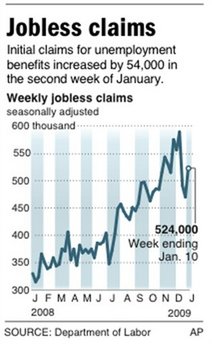
The record wave of layoffs that seemed to peak in December is continuing into 2009.
At the same time, hundreds of billions of dollars in aid are flowing from Washington to the banks and corporations, not to the unemployed. Reviving corporate profits has taken precedence over providing desperately needed jobs or calling for an immediate end to foreclosures and evictions.
Circuit City announced it is laying off 34,000 workers by the end of March—the largest mass firing since the current crisis began. This second-largest electronic retailer in the U.S. is closing 557 stores.
Just in the first two weeks of this year a series of other layoffs has been announced.
Motorola, which laid off 3,000 workers last October, has announced another 4,000 jobs will be cut. Hertz announced 4,000 jobs will go worldwide. ConocoPhillips will lay off 1,350, Pfizer 2,400, WellPoint 1,500, Saks 1,000 and Neiman Marcus 375. Advanced Micro Devices (AMD), Blue Cross/Blue Shield and other large companies are also scheduled to announce new rounds of layoffs.
These are only the most publicized firings.
The official unemployment rate, which was 7.2 percent at the end of 2008, is expected to shoot up rapidly in the coming months as the bosses continue the onslaught without mercy.
However, there is a less publicized but also official figure called “total” unemployment—and it has reached 13.4 percent. The first thing to remember about this figure is that it amounts to 20 million workers. It includes people who couldn’t get anything but part-time work when they need to work full time, plus the millions who have stopped looking altogether, termed “discouraged” workers.
At the present rate, millions more will lose their jobs in the coming months. Last year 2.6 million lost their jobs—a huge number but still deceptively low when trying to project what will happen this year because, of the 2.6 million, 2 million lost their jobs just in the last four months of 2008.
There is no question that an emergency jobs program, which would involve the immediate direct hiring of millions of workers at living wages, with benefits, and a freeze on layoffs, is urgently needed to stave off the growing crisis of the working class and the oppressed people.
However, instead of reaching out directly to assist the workers who are suffering from the capitalist crisis, Washington and Wall Street are reaching out to bolster the capitalist system and aid the capitalists who caused the crisis in the first place.
Why ‘stimulus’ can’t work
Wall Street told the incoming Obama administration to get hold of the $350 billion fund Congress passed to bail out the banks and use it to clean up their bad loans. In addition, the Democrats have submitted an $825 billion “stimulus” package.
There are many progressive features to the package, such as increases in Pell grants, reduction of payroll taxes for workers, rural assistance, additional food stamp aid and unemployment insurance. But these features, including the declared goal of creating 3 million jobs in the next two years, are utterly inadequate to meet the massive crisis that is unfolding at a rapid rate.
The package calls for $550 billion in direct spending over two years. Some 90 percent of this spending will go through private capitalists. The bill sets up contract procedures and deadlines that range from one year to more than two years for fulfillment. It has no mandatory hiring or wage requirements, save a nebulous “prevailing wage” stipulation. There is no requirement to stabilize employment by requiring that workers be retained for any period of time, nor any funds to provide such stability.
The 20 million workers already considered unemployed or underemployed—and this December figure is sure to rise in the new year—will have to wait for the stimulus package to go into effect. When it does, they will then have to compete for an estimated 1.5 million jobs to be created this year while the government bureaucracies at the local, state and federal levels negotiate contracts with competing capitalist interests and their lobbyists seeking to get a piece of the pie.
None of these bosses has the goal of providing good jobs at living wages with benefits. To them, the goal is to revive and maximize profits.
The entire process is corrupt, agonizingly slow, and totally uncertain as far as the workers are concerned. Furthermore, whatever hiring these bosses do could be cancelled out within a year or less by the drying up of funds or shrinking of the market.
The working class and the communities have no other recourse but to begin organizing on a mass basis to demand jobs now—at living wages.
Need for a direct jobs program
Millions are already unemployed. Millions more face layoffs unless an immediate, direct jobs program is put in place. It can be done. During the Great Depression of the 1930s, government jobs were put in place within two weeks after job programs were set up.
It won’t happen automatically. “Jobs or income” must become a mass demand, backed up by mobilizations, jobs marches and organizing the unemployed, in unity with the employed, who also need the security of jobs or income.
Regarding the bank bailout fund, $20 billion in cash and $100 billion in government-absorbed losses have been promised to Bank of America, which had already received $25 billion earlier. Citicorp is expected to announce $10 billion in new losses, which the government will absorb. Citigroup has already received $45 billion in bailout money and the government has given it a guaranteed backup of $300 billion to cover problematic loans.
The $350 billion bailout doesn’t include these huge new backup commitments. Its goal is to make the banks solvent by dealing with hundreds of billions—the investment bank Goldman Sachs says it’s more like $1 trillion—of remaining bad loans.
The fact is that these bad loans on the books of the banks are for the most part a mirror image of the suffering of the masses. Why are the loans of Citicorp, Bank of America and other banks going bad? Because of credit card defaults, auto loan defaults, student loan defaults, mortgage loan defaults and every other kind of unpayable debt. As people lose their jobs, have their wages and salaries cut, lose their health care, etc., they sink deeper and deeper into debt.
The bankers and the rich investors behind them are losing paper wealth, but their “balance sheet” problems arise from the direct material suffering of the masses. The working class and the middle class are unable to pay their bills, are losing their homes, their cars, their electricity and gas, their health coverage and every other means of survival.
Banks don’t lend when markets are glutted
The handout to the banks is being justified as an attempt to get them to start lending to companies and consumers, which will then get the economy rolling again. But this is a complete fiction. The problem of lending arises not from arbitrary stubbornness by the bankers. It arises from the lack of opportunity of the banks and the corporations to make profit once a crisis of capitalist overproduction hits, with its rising inventories and falling sales leading to falling production. After all, the bankers are in business to make profit.
The term “overproduction” has nothing to do with whether people need goods. It is when more commodities have been produced than can be marketed—i.e., sold at a profit.
The crude facts of capitalist overproduction are obvious. The U.S. auto industry has gone from producing 16 million cars annually to 13.2 million last year, and is expected to drop to 12 million or less this year. Steel production, which is a barometer of the economy, dropped from 2 million tons in November to 1 million tons in December. In recent decades, hundreds of thousands of steel workers were laid off as the industry consolidated and shrunk itself. Now, overproduction has hit again. It is estimated that 20,000 steel workers will be laid off in the coming period.
The overproduction of housing and the consequent crisis in the construction industry and all its ancillary industries is getting worse with each foreclosure.
Giant technology companies like Motorola, Nortel, AMD and Intel are suffering losses due to overproduction and hence executing layoffs. Under those conditions, the banks see no profit in lending, no matter how much money the government hands them.
In fact, they are using their bailout money not for lending but to strengthen themselves financially. According to a New York Times survey of two dozen banks, “The overwhelming majority saw the bailout program as a no-strings-attached windfall that could be used to pay down debt, acquire other businesses or invest for the future.”
At a recent conference at the Palm Beach Ritz-Carlton, “Bankers mingled with investment analysts at an ocean-front luxury hotel, where the agenda featured evening cocktails by the pool and a golf outing at a nearby country club.” They were there to discuss the bailout funds. Referring to the government’s Troubled Asset Relief Program, conference organizer John C. Hope III, chairperson of the Whitney National Bank of New Orleans, said, “We see TARP as an insurance policy.” Hope figures that, “No matter how bad it gets, we’re going to be one of the remaining banks.” (New York Times, Jan. 18)
So much for lending, job creation and recovery.
The “crisis” of the bankers and bosses is calmly discussed at luxury watering holes, while the workers are suffering the greatest attack in three generations.
The only way to get a real working-class recovery program is to organize to shake up the entire capitalist system until the bosses are forced to provide jobs and/or a livable income.
Goldstein is author of the recently published book, “Low-Wage Capitalism: Colossus with Feet of Clay,” which can be ordered through www.lowwagecapitalism.com.
Labels: Circuit City, jobs, layoffs, low wage capitalism, motorola, unemployment
By Fred Goldstein
Published Nov 20, 2008 10:38 PM
When Barack Obama first began his campaign back in 2006, he and his advisors and backers in the establishment had as a priority trying to deal with long-neglected aspects of U.S. capitalist society that were in decay and were endangering the world position of U.S. imperialism.
The festering issues of health care, global warming and energy, declining education, antiquated infrastructure, the global isolation of U.S. imperialism and many others were on the agenda for a future Obama administration, which was supposed to “reach across the aisle” and work out bipartisan solutions. But these were all policy issues, issues of capitalist decay arising during a period when bourgeois politics has been in a factional logjam, unable to resolve anything other than to hand the corporations whatever they asked for and attack the workers and the oppressed—during the Clinton as well as the Bush administrations.
Now, as Obama gets ready to take office, the policy issues he wanted to address all have to be subordinated to an acute systemic crisis that is global in scope and historical in proportion.
Some 1.2 million workers have lost their jobs so far this year. Unemployment has jumped from 6.1 percent to 6.5 percent and is projected to soon rise to over 7 percent. Consumer spending dropped a record 3 percent in October. Retailers are girding for the worst shopping season on record.
Citibank has just announced 10,000 new layoffs [two days after this speech, the number rose to 53,000—ed.]; Sun Microsystems has announced 6,000 new layoffs; Circuit City, the second-largest electronics retailer in the country, closed down 155 stores and is filing for bankruptcy; and the second-largest mall operator in the country, General Growth Properties, which operates 200 malls in 44 states, is on the verge of bankruptcy.
Intel, the largest microchip maker in the world, has suffered a major decline in revenue. Caterpillar, the largest construction equipment maker in the capitalist world, is planning for a downturn. GE, a giant multinational conglomerate, is planning to cut back investment and workers.
The auto industry is in crisis, with sales dropping and losses and layoffs rising. General Motors is hinting at bankruptcy in a public relations campaign to get a bailout from the Treasury—also a dangerous game of psychological warfare against the United Auto Workers, as the company is trying to set the stage to reopen contracts and get major concessions. GM recently announced it will end health care coverage for 100,000 white-collar retirees by the end of the year.
As the G-20 meet in Washington, the capitalist economies of Europe and Japan are in recession. This is the first time since World War II that the three major centers of imperialism—the U.S., Europe and Japan—have gone into recession within the same year. Japan, with the second-largest economy in the capitalist world, has had six consecutive months of contraction; Germany, the fourth-largest economy, has had six.
China, Brazil, Russia and India, the world’s most populous countries, have also had major declines in growth in the last quarter.
It is evident that there is a crisis of production and employment in the entire economic system.
The cause of the crisis can be reduced to two words: capitalist exploitation.
Why are all the toxic mortgages and other debt-backed securities going bad? Because they were based on collecting the future wages of the workers. Mortgage debt, credit card debt, school loan debt, auto loan debt, debt to pay medical bills, and all the other debts were bundled up and sold around the world. After 30 years of falling wages and a growing consumer credit system, the working class has become deeply indebted. African-American, Latin@, Asian and Native workers have suffered the most, especially single women.
Interest and fees on working-class debt have become a major source of profit for finance capital. The capitalist class, in its various forms as lenders, mortgage brokers, credit card companies, banks, auto finance companies and so on were taking advantage of the dire needs of workers in order to promote credit. These money grubbers turned around and resold the workers’ IOUs in bundles to make a quick profit.
Meanwhile, other sections of the capitalist class were intensifying the exploitation of workers on the job by busting unions, cutting wages and benefits, shortening hours, laying off and outsourcing to contract labor. The medical insurance industry, pharmaceuticals, hospitals, all raised costs to boost profits. Agribusiness and the oil barons raised the price of food and fuels, fueling inflation in the things workers need to live.
Sooner or later the whole debt structure had to collapse—and the cause was capitalist exploitation, i.e., the profit system.
The capitalist class has become more and more reliant upon debt as an artificial means of counteracting the growing problem of capitalist overproduction. As technology improves, the increased rate of exploitation and the worldwide wage competition drive wages down everywhere, making it harder for the capitalist system to generate a strong boom that can create jobs. This has become a long-term trend and signifies a new phase in the general crisis of capitalism.
Historically a capitalist recovery begins slowly as inventories are liquidated and then surges until there is another bust. Engels described the process of the classical capital bust-boom-bust cycle in his great work, “Socialism: Utopian and Scientific.”
His description still holds today, but with this modification. In the past several decades, the boom part of the cycle has become weaker and weaker. And it is this phase that creates a labor shortage, providing workers with jobs and putting them in a stronger position to bargain for higher wages.
The debt-fueled housing boom is an example of how U.S. capitalism has reached a stage of dependence upon debt to artificially stimulate the economy. The recovery from the last recession was a jobless recovery. From 2001 to 2004, after the dot-com collapse, profits were slowly recovering but jobs were still being lost. To pump up the economy and avoid a “double dip,” a lapse into a second recession, the Federal Reserve pumped billions of dollars of credit into the system by lowering borrowing costs for the banks. Much of the cheap money was used to finance the housing boom.
A housing boom is one of those areas, similar to auto, that ripples through the economy and multiplies jobs. It can help temporarily to push back a downturn. But the housing boom was all based on easy credit and speculation. It was bound to end. The price of housing went up. The supply went up. Soon there were more houses on the market than could be sold. A crisis of overproduction in housing ensued and the collapse followed, precipitating the credit crisis and the banking crisis that followed.
Without the housing boom, the economic crisis of overproduction might have come sooner.
If the present crisis were caused by financial manipulation alone, it could be cured by financial measures. But the Treasury under Secretary Henry Paulson and the Federal Reserve under Ben Bernanke have poured hundreds of billions into U.S. banks and are promising hundreds of billions more.
The German central bank has poured billions into their economy. The Bank of London has nationalized banks and also poured in hundreds of billions in bailout money. None of this has stopped the growing momentum of layoffs and short hours.
Why? Because this crisis is a crisis of overproduction. Bernanke can lower the interest rate to zero—Japan may do just that shortly. But even zero interest rates cannot produce lending if the workers are broke and there are no profits to be made in the marketplace. As they say on Wall Street, you can’t push a string.
Why would banks lend in an environment of economic crisis? It is not lack of funds or a matter of distrust that is keeping them from lending. Layoffs lead to lower spending which leads to lower profits and more layoffs. That is the classical capitalist cycle, but now it is gripping the entire capitalist world at once. There are no markets that are not shrinking. There is no haven in the world capitalist economy for investment and sales sufficient to pull them out of the crisis.
This is what globalization looks like in a period of contraction.
No one knows where this crisis is going. The Obama administration and the new regime of financial advisors may take measures to ease the foreclosure crisis and put some money into workers’ pockets. They may even try to create jobs building infrastructure. Of course, as a party, we support measures that will ease the suffering of the workers and the oppressed. But we also know that band-aids cannot overcome the contradictions of capitalism.
The beginning of a capitalist downturn hits the workers hard. The early phase of the struggle is defensive, to ward off the onslaught of layoffs and keep people in their homes. This was the course that the struggle took during the depression of the 1930s with the formation of the unemployed councils, and the move by working-class organizations to put hundreds of thousands of families back in their homes when they were evicted.
Our comrades in Detroit, Los Angeles, Boston and around the country are taking the initiative to begin those defensive struggles.
Later in the thirties came an offensive struggle with general strikes in San Francisco, Toledo and Minneapolis in 1934 and finally the great sit-down strikes of 1936 and 1937, which turned the tide in favor of the working class as a whole. We must be clear about what phase we are in, while retaining our revolutionary socialist perspective.
When the USSR and Eastern Europe collapsed, WWP chair Sam Marcy initiated a process of ideological rearmament—a study of Marxist and Leninist theory—in the anticipation that there would be a wholesale retreat from the revolutionary communist perspective.
From that period up until the onset of the present crisis, we have had to wage theoretical arguments to defend our position that the system of private property, in which a tiny group of millionaires and billionaires controls the means of life for billions of people around the globe, contains the seeds of crisis and disaster for the worldwide working class and the oppressed. With this current crisis, the question is no longer theoretical. The world capitalist crisis opens the door to struggle and to promoting socialism as the answer.
The workers need to own this vast, global system of production that they operate 24 hours a day and run society for human need and not for profit. This is the only way to abolish exploitation, racism, national oppression, sexism and patriarchy, oppression of LGBT people, imperialist war and intervention, and to tear down the walls of the prisons and their death houses.
Labels: bailout, capitalism, Caterpillar, Circuit City, Citibank, Citigroup, economic crisis, federal reserve, GE, Generlal Motors, layoffs, socialism, United Auto Workers, wall street